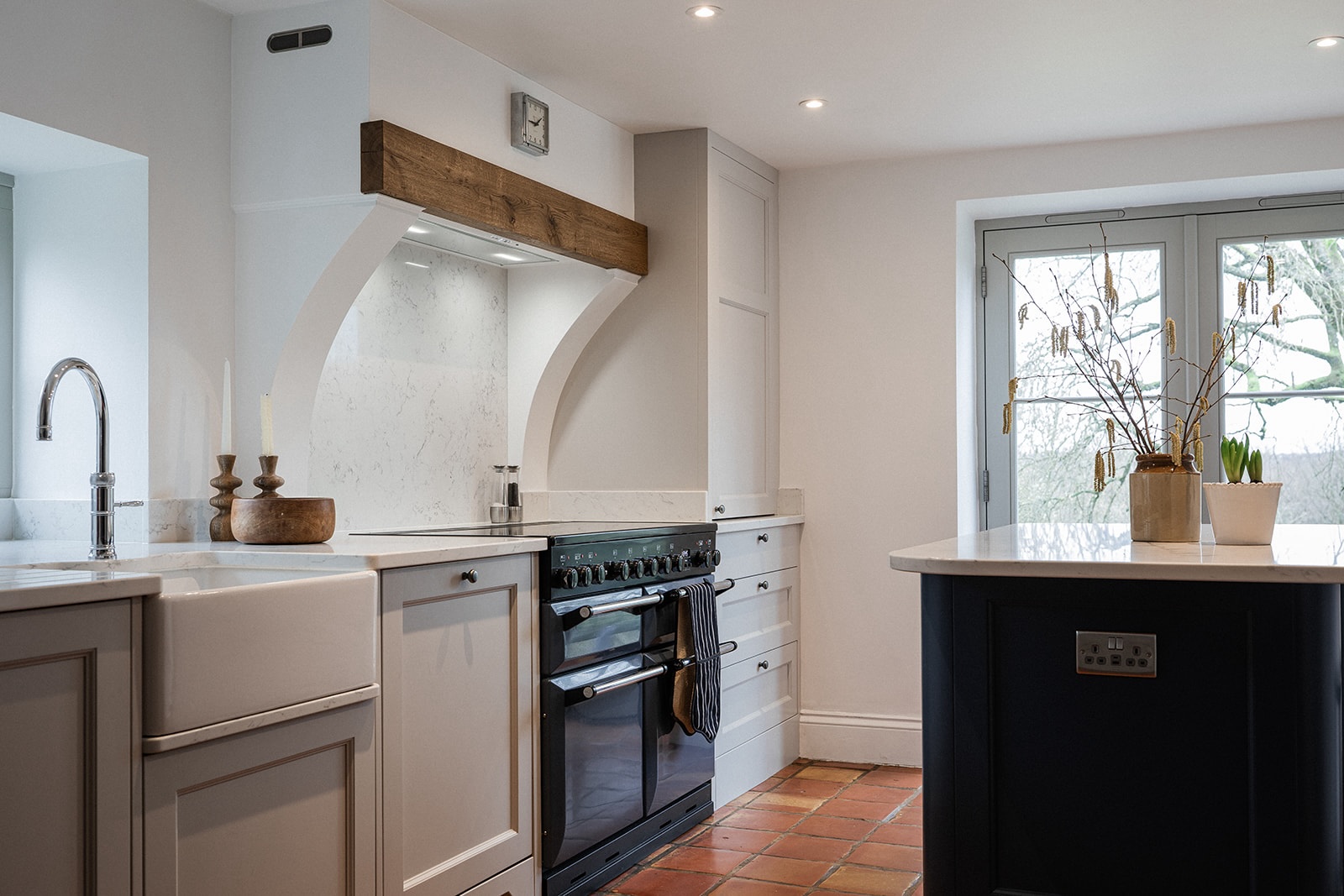
Not every kitchen starts with clean lines and perfect right angles. In fact, some of the most characterful homes come with exactly the opposite. Cottages, period properties and older buildings often bring uneven walls, sloping ceilings, alcoves and chimney breasts, with layouts that simply don’t follow modern dimensions. These are the spaces that tend to defy off-the-shelf solutions and often where thoughtful design makes the biggest difference.
1. Start with the space, not the catalogue.
In older homes, trying to force standard cabinetry into irregular spaces rarely works well. Instead, the design needs to respond to the room itself. That might mean working with angles rather than hiding them, allowing for variation in wall depth and building in flexibility from the outset. In these situations, a bespoke approach becomes less of a luxury and more of a necessity.
2. Use cabinetry to bring clarity to complexity.
A well-designed kitchen can quietly resolve a lot of visual noise. Simple, consistent cabinetry helps to create a sense of order, even when the structure of the room is far from perfect. It can straighten visual lines, bring balance to an irregular footprint and allow the character of the building to remain without feeling chaotic. The aim isn’t to erase the quirks, but to work with them in a more considered way.
3. Make awkward spaces work harder.
Some of the most useful storage comes from the most unexpected places. In older homes, this often means making the most of what might otherwise be overlooked. Angled cupboards within sloping walls, shallow storage where depth is limited, or bespoke shelving within alcoves can all become highly functional parts of the kitchen. These details are rarely compromises. More often, they’re where the design becomes most thoughtful.
4. Accept that no two measurements are the same.
In a modern build, consistency is expected. In an older property, it’s rarely the case. Walls shift, floors move, and dimensions vary more than you might expect. This is where careful surveying, precise making and a team that can adapt on site become essential. It’s often this level of attention that defines how well the finished kitchen comes together.
5. Choose a team that can design, make and install.
When working with complex spaces, continuity matters. Having one team responsible for the design, making and installation means decisions are carried through properly, without compromise between stages. It creates a smoother process and a more resolved end result.
A considered approach for characterful homes.
As one recent client shared with us, their cottage kitchen had “Wonky angles that defied off-the-shelf solutions and required a more bespoke approach.”
These are exactly the kinds of spaces where thoughtful design and careful making come into their own. Older homes don’t need to be simplified to work well. They just need to be understood.
If you’re thinking about your own kitchen and would like to talk things through, you’re very welcome to visit our showroom or arrange an initial conversation with the team.
